
Every time hotel rooms turn over, housekeeping teams face the same problem: mattresses may look clean on the surface, yet stains have already seeped deep inside. No amount of wiping can fully eliminate bacteria and contaminants trapped within the core. When full‑mattress replacement becomes unavoidable, procurement costs can be substantial — not to mention the logistical pressure of warehousing for frequent turnover.
Against this backdrop, a growing number of hotels are adopting washable hotel mattresses as a standard offering, rather than a niche option. Washable hotel mattresses fitted with removable zipped covers are evolving from an industry experiment into a mainstream trend. This guide explains their design principles, reasons for adoption, proper care and maintenance, and a structured purchasing framework to help procurement teams make well‑informed decisions. Some factory‑direct commercial mattress brands have already rolled out this design, steadily lowering industry barriers.
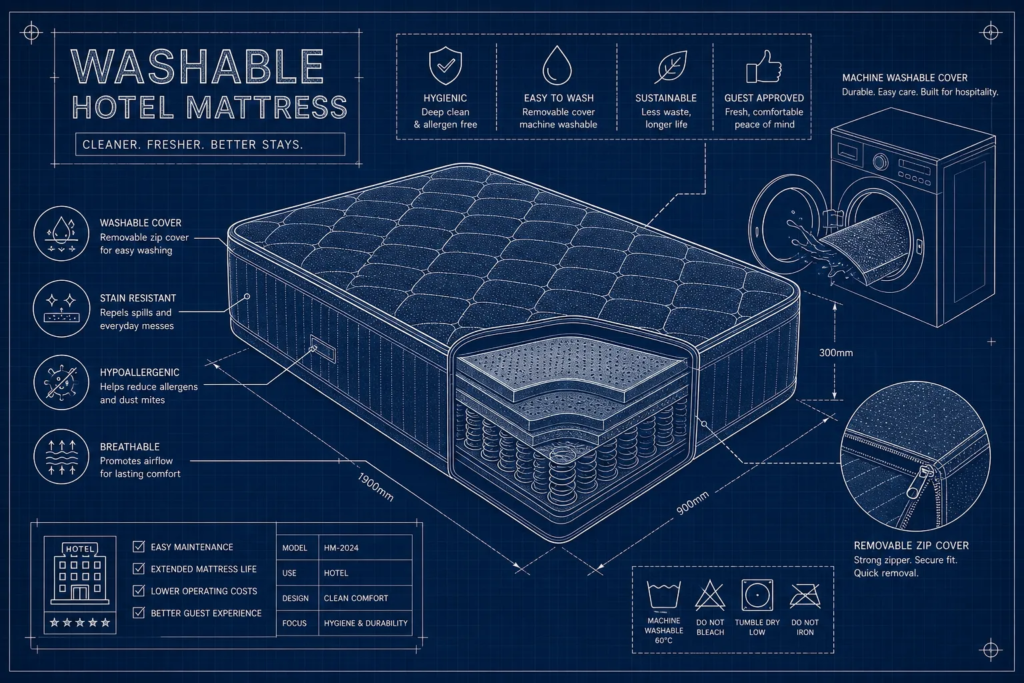
What Exactly Is a Washable Hotel Mattress?
This term is frequently misunderstood. “Washable” does not mean you put the entire mattress into a washing machine. Instead, the mattress comes with a removable, zipped outer cover — this cover is the core component engineered for repeated industrial laundering. The mattress core stays intact; housekeeping staff quickly remove, launder and refit the cover to restore the mattress to like‑new condition.
Core Differences: Design Logic of Zipped Removable Covers vs. Conventional Mattresses
Traditional fixed mattress covers act only as passive surface protection. At best they can be wiped with a damp cloth, with no real disinfection possible. Removable mattress covers form an integrated part of hotel hygiene management: they function as independent washable units that can be cleaned, sanitized and replaced without disturbing the mattress core.
Commercial‑grade zippers must withstand frequent opening‑closing cycles and mechanical stress from industrial washing. During procurement, request zipper cycle‑life test reports or relevant industrial laundering certifications from suppliers to verify real‑world performance matches marketing claims.
What “Commercial‑Grade” Means Under Industrial Laundering Standards
Hotel on‑premise laundries operate very differently from household washing machines: large‑capacity drums, high‑frequency cycles, and specific temperature ranges required for proper sanitization.
For hotel‑grade washable mattress covers, the recommended washing temperature range is 40 °C‑60 °C (always follow product care labels). They must pass industrial laundering durability testing without pilling, fading, or loss of antimicrobial coatings. Fabrics should retain their shape and functional properties after repeated washes to meet true hotel‑spec standards.
Why Hotel Operators Are Rapidly Adopting This Design
Analysis of guest reviews across major booking platforms shows rising guest sensitivity toward bed cleanliness. Mattress hygiene has become a key factor shaping guest ratings. This puts mounting pressure on legacy practices relying on non‑washable mattresses.
Once stains penetrate the core of a conventional non‑washable mattress, operators face a dilemma: replace mattresses prematurely and raise costs, or continue using them with hidden hygiene risks.
Hygiene Compliance and Guest Trust
The most immediate value of removable washable covers lies in verifiable cleanliness for every new guest. Covers are removed, industrially laundered and sanitized between stays, rather than merely surface‑tidied. Fixed‑cover mattresses cannot deliver this provable standard of hygiene. In an era where negative reviews directly impact booking conversion, this operational detail carries tangible business weight.
Real‑World Comparison: Replacement Cycles and Operating Costs
The economics are straightforward. When removable covers absorb most day‑to‑day soiling, the mattress core is well‑protected and its service life can be extended. According to supplier data and industry reports (e.g. Swissfeel), operators using washable hotel mattresses can achieve 20%‑50% savings in overall mattress procurement costs. Exact savings depend on usage intensity, laundering protocols and product selection.
The gap between initial purchase price and cumulative costs from premature core‑damage‑driven replacements is often larger than procurement teams anticipate. This is where genuine long‑term return‑on‑investment comes into play.
Selecting Materials & Construction: Factors That Determine Washability and Service Life
Products marketed as “washable” vary widely in quality. Outer‑cover fabric selection and mattress build directly determine performance after repeated industrial laundering. This is frequently overlooked yet critical for controlling long‑term expenses.
Field‑Proven Fabric Options for Commercial Repeated Laundering
Several fabric technologies validated for hotel applications deserve procurement attention:
- Silver‑ion antimicrobial fabric: delivers reliable bacteria‑inhibition performance under hot‑humid conditions. Look for products with silver ions embedded into fibres (not only surface‑sprayed coatings). Some brands claim retained antimicrobial activity after 50 or even 100+ industrial washes. Always ask suppliers for third‑party lab antimicrobial test reports to validate such claims. This fabric is especially well‑suited for Singapore’s persistently hot‑humid climate.
- Tencel™: excels in moisture‑wicking breathability, soft hand‑feel and shape retention after washing. Ideal for hotels prioritizing comfort and sustainability positioning.
- High‑breathability mesh fabric: prioritizes ventilation and moisture resistance, lowering mould‑growth risk in humid environments. Request breathability and anti‑mould test data from suppliers for performance validation.
Bamboo‑charcoal fibre offers limited auxiliary anti‑mould benefits, yet independent test data for dedicated antimicrobial performance remains limited. It should not be relied upon as a primary antibacterial material. For Singapore‑style tropical humidity, silver‑ion treated fabric remains the most evidence‑based first choice.
Why Glue‑Free Heat‑Pressed Construction Suits Washable Designs
Mattresses built with traditional adhesive have a key weakness: high‑temperature laundering accelerates glue‑layer degradation, leading to material shifting and odour issues. Glue‑free heat‑press bonding fuses components using hot‑melt materials instead of chemical adhesives.
In theory, heat‑pressed structures deliver superior durability through repeated wash cycles. Actual performance depends on material formulation, manufacturing parameters and laundering conditions. Require suppliers to provide third‑party structural‑integrity test reports covering 50 or more industrial wash cycles before concluding it outperforms conventional builds.
Proper Laundering Workflow: Maximize ROI From Washable Mattresses
Many hotels purchase removable‑cover mattresses yet shorten cover service‑life through incorrect laundering. Correct industrial‑laundry procedures unlock the full value of the investment. Every parameter directly impacts cover longevity and functional‑layer durability.
Guidelines for Temperature, Spin‑Cycle and Drying
Below are general reference parameters; always follow product care labels and obtain official industrial‑laundering instructions from your supplier:
- Wash temperature: typically 40 °C‑60 °C. Use 60 °C for enhanced sanitization; 40 °C‑50 °C works for routine room turnover.
- Spin‑drying: limit to 3‑5 minutes. High‑speed spinning damages textile fibre structure.
- Drying: low‑temperature tumble‑dry or air‑dry preferred. High‑heat rapid drying may degrade waterproof membranes or antimicrobial coatings.
- Detergent: use adequately diluted neutral detergents. Avoid bleach, fabric softeners and high‑alkaline formulas, which cause discoloration and functional‑layer damage.
Anti‑Mould & Anti‑Bacteria Tips for Singapore’s Hot‑Humid Climate
Even between washes, proper handling of mattress covers matters in year‑round hot‑humid conditions. Air‑dry covers promptly after use; avoid long‑term storage while damp. Maintain sufficient air circulation inside guest rooms to mitigate mould risk.
Relying solely on periodic laundering cannot fully control mould risk. For tropical climates, prioritize fabrics with durable antimicrobial and anti‑fungal treatment at the product‑selection stage, instead of reacting once problems emerge.
Practical Purchasing Framework for Washable Hotel Mattresses
For hotel procurement teams and institutional housing operators, this framework helps filter genuinely commercial‑grade products instead of falling for marketing‑only “washable” labels. Washability is only the baseline; supplier customization capability, manufacturing standards and supply‑chain stability are equally vital for long‑term partnerships.
Core Metrics for Evaluating Commercial Mattress Suppliers
Before engaging suppliers, assess these dimensions item‑by‑item:
- MOQ (Minimum Order Quantity): align with project scale. Factory‑direct supply commonly requires 30‑50 units per model (figures are typical; confirm with individual manufacturers).
- Lead time: standard production lead‑time: 15‑25 working days. Sample development: 7‑10 working days (typical ranges; confirm formally with suppliers).
- Test reports: demand industrial‑laundering durability test reports for cover materials, do not rely only on marketing copy.
- Customization capacity: OEM / ODM capabilities should cover custom dimensions, firmness levels, brand‑logo printing, fabric combinations and packaging solutions.
Value of Factory‑Direct Solutions: The EasyRest Example
More hotel procurement teams choose to work directly with commercial mattress factories to eliminate markup from intermediaries.
EasyRest offers commercial‑grade mattresses with zipped removable washable covers, including silver‑ion antimicrobial, Tencel™ and high‑breathability mesh functional fabrics engineered for industrial laundering. Mattress cores adopt glue‑free heat‑pressed construction to preserve structural stability after repeated washing cycles.
For hotel groups seeking standardized bulk procurement and controlled long‑term operating expenses, factory‑direct options deliver pricing transparency and flexible customization worthy of evaluation. Request samples to verify real‑world quality and fabric wash‑resistance before requesting bulk quotations.
Investing in Washable Mattresses Is an Operational‑Efficiency Decision
Selecting commercial mattresses with removable washable covers is far more than a hygiene upgrade. It is an operational choice that reshapes replacement‑cost structures and guest reputation.
This guide outlines key evaluation dimensions: structural design, fabric selection, correct laundering workflows and supplier assessment — all directly influencing long‑term total cost of ownership.
Evaluate full‑lifecycle costs of removable‑cover mattresses instead of focusing purely on unit price: that defines smart procurement. If you are planning upcoming commercial‑mattress procurement, contact the EasyRest team for sample evaluation. Confirm physical quality and fabric wash‑performance before proceeding with factory‑direct quotation requests.