
You probably know the rule of thumb. Replace your mattress every 7–10 years. But almost nobody knows why that number exists. What’s actually happening inside a mattress while you sleep on it, night after night, for a decade?
The mattress doesn’t just “wear out” in a way you can see. Instead, a slow and invisible process happens at the material and microbiological level. Here’s the science behind it.
Your Mattress Is Absorbing You — Every Single Night
An average adult loses roughly half a liter of sweat per night, even in a cool room. Over a year, that adds up to close to 180 liters of moisture. All of it goes into your mattress. On top of that, the average person sheds about 500 million skin cells a day, and a portion of them end up in your bedding. Together, sweat and skin cells create the two core ingredients for the real driver of mattress aging: dust mites.
Dust mites don’t bite you, and they don’t carry disease directly. However, they feed on shed skin flakes, and their droppings contain a protein called Der p 1 — one of the most common indoor allergens in the world. A used mattress can house anywhere from 100,000 to over 10 million dust mites. In fact, after just a few years of regular use, dead mites and their waste can make up a significant percentage of a mattress’s total weight. For people with asthma or dust allergies, an aging mattress isn’t just uncomfortable. It’s a measurable trigger.
The Foam Itself Is Changing Shape, Slowly
Moisture and mites aside, the materials inside your mattress also undergo their own physical decay over time:
- Polyurethane foam breaks down through a process called compression set. Essentially, the cell structure of the foam gradually loses its ability to spring back after repeated pressure. Labs test this by compressing a foam sample thousands of times and measuring how much thickness fails to recover. Most quality mattress foams can handle 80,000+ compression cycles — roughly 8–10 years of nightly use — before support noticeably degrades.
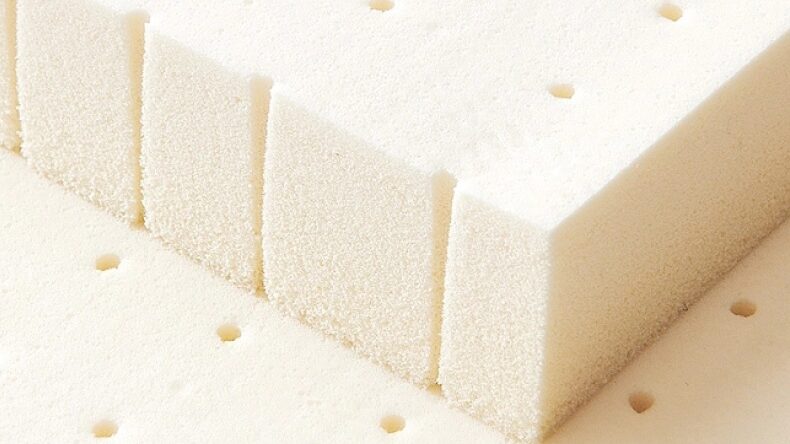
- Latex, by contrast, resists compression set far better than polyurethane. It typically survives several times more compression cycles, which is why natural latex mattresses are often rated for longer lifespans.
- Pocket springs face a different challenge: metal fatigue from years of flexing. A well-manufactured tempered-steel spring resists this for a decade or more. However, tempering quality varies significantly between manufacturers, which explains why two mattresses that look identical can age at very different rates.
Over time, this material fatigue creates what sleep researchers call “the trough effect” — a dip that forms where your body weight concentrates most, usually the hips and shoulders. Once that dip exceeds roughly 1.5 inches (about 4 cm), most sleep and spine specialists agree the mattress can no longer provide proper spinal alignment, regardless of its actual age.
So What Actually Determines the “Right” Number?
There isn’t really a single universal number. Instead, mattress lifespan depends on four measurable factors:
| Factor | Faster Aging | Slower Aging |
|---|---|---|
| Material | Basic polyurethane foam | Natural latex, high-density pocket spring |
| Body weight & usage | Heavier body weight, daily nightly use | Lighter use, guest room |
| Humidity of sleep environment | Humid climates accelerate mite growth | Dry, well-ventilated rooms |
| Manufacturing quality | Lower-density foam, thin fabric layers | Higher-density foam, reinforced edge support |
For this reason, sleep researchers and mattress engineers describe lifespan in ranges tied to material, not a single rule:
- Basic polyurethane foam mattresses: 5–7 years
- Standard innerspring mattresses: 6–8 years
- Pocket spring mattresses (quality tempered steel): 8–10 years
- Natural latex mattresses: 10–15 years, sometimes longer
Three Signs Your Mattress Has Reached the End — Before the Calendar Tells You
- You sleep noticeably better in hotels or other beds. This is one of the most reliable signals sleep clinicians point to. If unfamiliar mattresses consistently feel more supportive, your own mattress has likely degraded.
- Visible or palpable sagging. Lay a straight object, like a broom handle, across the mattress surface. A gap of more than an inch or two underneath it points to compression set.
- Increased allergy symptoms at night. Sneezing, congestion, or itchy eyes right after lying down can mean your dust mite population has outgrown what regular cleaning can manage.
What Actually Slows the Aging Process
None of this means you’re powerless for a decade. In fact, a few evidence-backed habits can meaningfully extend your mattress’s life:
- Use a breathable, washable mattress protector. This is the single most effective barrier against both moisture and mite colonization.
- Rotate the mattress 180° every 3 months (for mattresses without a designated top/bottom) to distribute compression more evenly.
- Keep bedroom humidity below 50%. This sits below the threshold dust mites need to reproduce efficiently.
- Vacuum the mattress surface every few months with a HEPA-filter vacuum.
The Bottom Line
“Replace your mattress every 7–10 years” isn’t an arbitrary marketing rule. It’s a rough average of when foam compression set, spring metal fatigue, and dust mite accumulation typically converge to measurably reduce comfort and sleep quality. The real answer for your mattress depends on its materials, your body weight, your climate, and how well it was built in the first place. That’s exactly why construction quality matters as much as the mattress itself.