
Pocket Springs vs. Open Coils: The Ultimate Mattress Spring Guide
When shopping for a new mattress, many buyers focus exclusively on top comfort layers like memory foam, latex, or pillow tops. However, the mattress spring core is the true structural backbone of your bed. It determines spinal support, motion isolation, airflow, and overall durability.
If you wake up with back stiffness or find yourself disturbed every time your partner turns over, your spring support system may be to blame. In this guide, we break down the mechanics of pocket springs versus traditional open coils to help you choose the best mattress for your sleep needs.
1. Core Types: Pocket Springs vs. Traditional Open Coils

Independent Pocket Springs
Each steel spring is individually encased in a non-woven fabric pocket and bonded together laterally.
- Zero Motion Transfer: Springs move independently, dampening motion from partner movement.
- Ergonomic Contour: Adapts to heavy zones (hips, shoulders) for natural spinal alignment.
- Whisper Quiet: Fabric casing eliminates metal-on-metal friction and squeaks.
Traditional Open Coils (Bonnell)
Coils are interconnected using a continuous helical steel wire to form an integrated spring network.
- Firm & Robust: Delivers a rigid, supportive feel with excellent edge strength.
- High Durability & Value: Proven design that resists sagging at an affordable price point.
- Motion Transfer: Movement on one side creates a wave effect across the mattress.
2. Key Technical Specifications to Consider
When evaluating high-quality pocket spring mattresses, three primary technical metrics define performance:
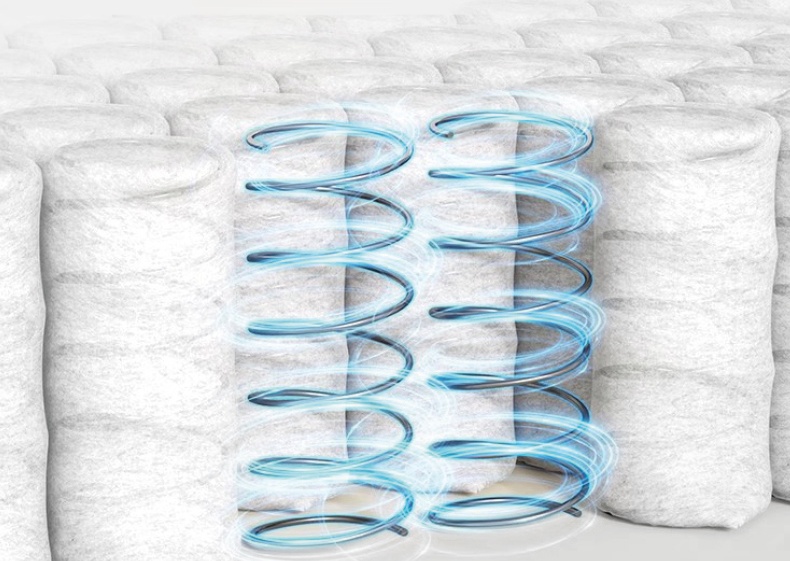
A. Wire Gauge (Thickness)
Wire gauge refers to the thickness of the steel wire used in each spring, typically ranging from 1.8mm to 2.3mm. A lower millimeter count indicates a thinner, softer spring, while a higher millimeter count provides firmer, heavy-duty support.
B. Coil Turns (Spiral Count)
The coil turn count represents how many times the steel wire wraps around from top to bottom (usually 5.5 to 6.5 turns). Higher turn counts allow greater compression travel, improving shock absorption and pressure point relief.
C. Ergonomic Zoning
Zoned spring systems incorporate varying wire gauges across different sections of the bed (e.g., 3-Zone or 5-Zone). Firmer coils support the lumbar and hip regions, while softer coils cushion the shoulder and leg areas.
3. Buyer’s Comparison Matrix
| User Profile | Recommended System | Key Benefit |
|---|---|---|
| Couples & Light Sleepers | Independent Pocket Springs | Maximum motion isolation and silent support. |
| Back Sleepers / Heavyweight | Reinforced Gauge Pocket Coils | Prevents deep sagging; maintains healthy posture. |
| Children & Teenagers | Firm Pocket Springs (1.9–2.1mm) | Proper ergonomic backbone support for growth. |
| Budget / Guest Bedrooms | Traditional Open Coils (Bonnell) | Durable, simple construction, cost-effective. |